Written by: Maitong MSX Researcher
We can't change what's past, but we can still shape what's to come.
2025 has passed in the blink of an eye. In this year, the global financial market has undergone round after round of "extreme stress tests": geopolitical fluctuations, volatile macroeconomic expectations, narrative retreats and liquidity divergences have occurred in an intertwined manner. At the same time, tokenization has quietly accelerated under the impetus of compliance and infrastructure.
It can be said that from TradFi to Web3, two originally parallel forces are converging at an unprecedented speed, aiming at the on-chain and programmable nature of various financial assets.
In order to restore the market's "sentiment" into a "sample" that can be used for reference, we used MSX as an observation sample and posed nine questions to our internal researchers: from annual keywords, personal gains and losses and core positions, to the overflow path of funds, the judgment of the ownership of pricing power, and the key structural variables that may trigger the "ChatGPT moment" of TradFi × tokenization. We have compiled these questions into an article for our readers.
As a collective review from frontline builders, we hope that everyone can gain insight into the gains and losses of US stocks/tokenization/Web3 in the eyes of users this year, and perhaps also learn from this experience to discover the hidden potential and gain a survival guide for 2026.
Note: The analyst's holdings disclosure is for illustrative purposes and research discussion only, and does not constitute any investment advice.
I. Flashback to 2025: Gains and Regrets of US Stocks/Web3
1. Looking back at 2025, what do you see as the biggest change in the US stock market or the tokenization sector? If you had to summarize it with one keyword, what would you choose?
DaiDai: I think 2025 will be a turning point for the US stock market, shifting from "narrative-driven" to "substantial implementation". The key words to summarize it are "value return".
In particular, the monetization of "capital expenditures" (CapEx) related to AI is subject to a full-year performance test. The market is clearly no longer buying into the simple "AI story" but is paying close attention to whether the capital expenditures of tech giants can be converted into actual revenue.
LittleFox: My keyword is "regulatory-driven technology application".
The biggest change in 2025 was the trend of convergence between traditional finance and Web3. This trend was directly reflected in the increase in the number of stablecoins and their daily applications. It was very evident that the crypto market experienced a loss of trading funds and an overall downturn in 2025, failing to maintain its bull market momentum. However, crypto technology has begun to become part of the infrastructure of traditional finance. Market logic is constantly changing, but according to the normal distribution trend, traditional finance, especially the US stock market, will receive more technological support from the crypto market, thereby gaining more users globally.
Echo: If I had to give a keyword, I think it would be "playability".
From my experience and that of my friends who are both crypto veterans and US stock market newbies, the point of excitement has shifted from "the lower barrier to entry for investing in US stocks" to "how to play with tokenized US stocks on the blockchain." In fact, this field is so engaging that people are no longer just talking about the story.
Value no longer depends solely on how exciting the future of the story is, but also on how fun the tool is, how it can be used, and whether it can combine the advantages of both to create an even higher ceiling. Experienced players in both stocks and crypto should be thrilled. Something as reliable as Apple stock has become a "financial Lego" on the blockchain: it can be held, staked, earn interest, or even used as leverage, and can be instantly switched between multiple states that are encapsulated into derivatives, with states that can be superimposed.
Frank: If I had to summarize the US stock tokenization sector in 2025 with one keyword, I would choose "acceleration".
This "acceleration" does not stem from a single event, but rather from the simultaneous advancement of a whole set of infrastructure and institutional frameworks. This includes the forward-looking discussions on compliance and a significant shift in attitudes toward "on-chain" issues. In fact, whether it's Nasdaq's shift from being an observer to actively participating, or the proposal of the 5x23-hour trading experiment, it all signifies that these Wall Street players are no longer merely testing the waters, but are beginning to dismantle the old world's barriers themselves (further reading: "Nasdaq Steps on the Gas: From 'Drinking Soup' to 'Eating Meat,' Is the Tokenization of US Stocks Entering the Decisive Battle? ", "US Stocks Sprint 'Never Close': Why Did Nasdaq Launch the '5x23-Hour' Trading Experiment? ").
In contrast, my overall impression of the US stock market in 2025 was "turbulent." After all, the year was not peaceful, with events such as the sharp drop in April and the impact of tariffs and geopolitical turmoil. However, what was amazing was its strong recovery ability and efficient sector rotation. From AI and chips to power, copper, storage, nuclear energy and infrastructure, almost every stage had a new narrative to take over.
It's fair to say that 2025 further widened the cognitive gap between US stocks and cryptocurrencies. In my view, US stocks are more like a deep ocean, while cryptocurrencies remain as several fragmented ponds. More importantly, US stocks are backed by real profits and cash flow, which allows their valuation logic to be repeatedly validated—something that almost 99% of Altcoins cannot match.
Keaton: My keyword is "second half".
From my perspective, blockchain has finally entered its second half, moving towards compliance and maturity. It has finally returned to its original purpose, competing with the previous generation of opaque settlement systems in traditional finance by offering superior clearing and settlement efficiency.
With user scale and product experience finally reaching the eve of a singularity, we can now support some Mass Adoption level use cases.
L: Looking back at 2025, if I had to summarize the biggest changes in the US stock market and tokenized asset sector with one keyword, I would choose "implementation".
To put it simply, "tokenized trading will truly take hold" in 2025. This is because, from STO to tokenization, tokenization has remained largely a concept for the past few years, while in 2025 it will focus on liquidity, trading depth, and real-world use cases.
Users are no longer just concerned with "whether assets are on-chain", but with "whether they are easy to trade and whether they are worth participating in for the long term".
Ariaina: Looking back at 2025, I believe the emergence of tokenization in the US stock market is an important signal that on-chain assets are beginning to undergo structural changes.
The concept is not new. In earlier cycles, the market had tried putting different types of real-world assets, such as US Treasury bonds and real estate, on the blockchain. These explorations had their own rationale at each stage, but overall, they were more of a supplement to the types of on-chain assets and did not really enter the mainstream or change the core structure of on-chain assets.
Against the backdrop of global economic pressure and tightening liquidity, the Web3 market itself can no longer rely solely on native crypto assets for new growth. However, the tokenization of US stocks, as the most mature, liquid, and easily understood asset class globally, has not only opened up an asset space for Web3 far larger than its own size, but has also effectively established a more direct connection between traditional finance and Web3.
From the perspective of ordinary users, this is a more natural path—users do not need to understand complex encryption concepts first, but can start with familiar assets and gradually enter the on-chain system.
Therefore, if I had to summarize this change in one word, I would choose "opening up"—not opening up a particular product or entry point, but opening up the ceiling of on-chain assets and also opening up the boundary of the long-standing isolation between Web3 and mainstream finance.
2. What was your most satisfying investment move in 2025, and what was your most regrettable miss the pump or loss? (Not limited to US stocks/cryptocurrency)
DaiDai: This year I did indeed pick most of the trending stocks, such as OKLO, RKLB, IREN, NBIS, ASTS, SNDK, MU, OPEN, etc. That's right! I just love following trends and especially like trending stocks.
Meanwhile, in terms of precious metals, I also profited from gold and silver, and cleared out ETH at 4000+ (in retrospect, it was another kind of "successful top exit"). The biggest regret is not taking advantage of the pullback in October and November to buy back MU and SNDK.
LittleFox: My personal trading principle is "following the trend to avoid disaster, and going against the trend to achieve success." I focus on high-frequency trading on the left side of the trend, but more often I combine macro data, company data, and other fundamental information with the rhythm to find opportunities to enter the market.
The most satisfying trade this year was in November. The market experienced a general decline due to fundamental pressures, but I predicted that Nvidia's earnings report would act as a stabilizing force to lift the market. This was because Nvidia had essentially completed all its sales targets by the beginning of the year, and I couldn't think of any reason for its earnings report to be disappointing. So, I increased my leverage and bought at a relatively good price. (Aside: Looking back now, the leverage I used was somewhat of a gamble, because if Nvidia's earnings report had been disappointing, it would have resulted in significant losses. I don't encourage this kind of behavior.) This trade was an opportunity to monetize my knowledge. Besides making some profits, the biggest benefit was the sense of accomplishment I felt from realizing my knowledge, which is why it's so memorable.
If you regretfully miss the pump, it means that the precious metals market has barely touched the price movements until it rises to a level that I already consider outrageous, at which point I start to do in-depth analysis of precious metals. However, by then, there are no suitable entry points in my trading system, and I can only watch from afar. This is regrettable because when precious metals show unusual movements, in-depth analysis should be emphasized.
Echo: The most comfortable approach is dollar-cost averaging and taking profits on BTC, SOL, and BNB.
The biggest regret is the emotional buying of Trump and CFX and the letting the losses go unchecked. I haven't participated in any other meme projects since then, and I feel like I have absolutely no knack for emotional investing. As for US stocks, I threw some of my New Year's money into MSTR at the beginning of the year, but didn't make any significant gains.
Taking profits is the greatest respect for trading; let's all strive for that.
Frank: Frankly, I don't have many active investments in the Crypto space in 2025.
Conversely, due to the influence of my work, my several transactions in the US stock market turned out to be unexpectedly pleasant surprises this year. These included my phased allocations to Google (GOOGL) and XPeng Motors (XPEV), which yielded relatively good returns and made me vaguely aware that this might be a turning point in my personal investment path.
For some time now, I've been more accustomed to looking for opportunities on-chain, between different protocols, and between on-chain and CEX/platforms, mainly focusing on stablecoin arbitrage. So, holding USDT/USDC long-term has allowed me to obtain relatively stable "snack-level" returns. However, since I started to delve deeper into US stock investment research in the second half of 2025, I've realized a problem, which I just discussed with a friend today:
With my Web3 Native background (which I'll call myself for now), my current investment logic is somewhat of a "hybrid"—I haven't established a systematic value investing framework based entirely on the mature US stock market, and I'm gradually becoming unaccustomed to the highly emotional, purely speculative nature of the Crypto world.
This is why I have always been cautious about some high-explosive meme or pure narrative projects, and I increasingly agree with a conclusion I've come to: people with a background in US stock investment often find it much easier to switch to crypto than pure crypto players to enter the US stock market.
As for regrets, there aren't any. Although GPS (GoPlus) has been heavily invested in and I've been constantly adding to my position, it's all based on my trust in the project team and my observation of the security logic for end users. It's not like I've stepped on a landmine. The market is willing to take the hits, and I'm willing to bear the losses.
L: If I had to choose, the most comfortable thing I did in 2025 actually had one thing in common: I didn't deliberately try to be "smarter," but instead chose to stand on the side of certainty.
In the US stock market, I focus more on AI infrastructure and energy, such as VST and CEG. These aren't the most talked-about stocks every day, but the logic is very clear—AI ultimately needs electricity and infrastructure to be implemented. I don't chase highs or trade frequently; I'm willing to buy on dips, and the holding period feels very secure.
On Crypto, I continued my spot trading and long-term investment approach. Rather than chasing new narratives, I prefer to hold BTC and a small amount of assets with clear infrastructure attributes for the long term. These positions don't require constant monitoring, but they allow me to stay on the table and follow the overall industry trend.
The most regrettable aspect is actually quite consistent. Whether it's commercial aerospace in the US stock market (ASTS, RKLB) or the AI + Crypto and Restaking sectors that experienced a phased boom in Crypto, I understood the logic, but I chose a more conservative pace in execution, missing out on the steepest part.
Looking back, I don't entirely regret it. One thing that made me more certain in 2025 is that some market movements are meant to "prove that the market is resilient," while some positions are meant to accompany you in the long run. I prefer to focus my energy on the latter.
Ariaina: If I had to pick my most "comfortable" investment move in 2025, it wouldn't be anything particularly brilliant, but rather quite boring—continuing to hold BTC for the long term. As a veteran BTC dollar-cost averaging investor, this year was basically about mechanically adding to my position: buying when it went up, buying when it went down, mainly based on the principle of "I don't know what the market is trying to do, but I don't want to guess." Not particularly smart, but I slept pretty well.
Besides BTC, I also allocated a small position in BNB this year. Platform tokens haven't had a good reputation in recent years, and everyone says they don't have much long-term value. When I bought them, my mindset was quite mixed: I was skeptical on one hand, but I couldn't resist trying them out on the other. As a result, BSC was given a boost in application scenarios this year by Alpha Meme, which provided some consolation for someone like me who was half-believing and half-doubting.
If I had to pick the most regrettable move, it would definitely be TRX. In my youthful ignorance, after abandoning TRON, I practically gave away the remaining TRX to a friend as "electronic waste." Who would have thought that Sun would actually be able to take TRON to Nasdaq? The biggest lesson I learned from this wasn't missing out on some money, but that you can look down on a project, but never underestimate a founder who can keep pushing things and always manage to survive.
In addition, 2025 was the year I started trading contracts again after a two-year hiatus. The strategy was actually quite honest: "medium to long term, only playing in bull markets." Judging from the order win rate, the results weren't bad. The problem was with myself—even though it was a strategy-based trading approach, I ultimately let my emotions take over the account. During the September drop, rationality failed me, panic took over, and I failed to avoid it in time. It was a case of the system not breaking down, but my mind collapsing first.
Looking back on this year, whether I made money or not is no longer the most important thing. The more realistic feeling is that the market changes every year, but I still need to retake my emotional management course every year. One more thing about US stock investing: as a complete novice, this year I stumbled upon the AI train through "MaiMai Yanxuan" (a Chinese investment platform). Honestly, I used to be somewhat dismissive of traditional financial markets, thinking they were slow-paced and lacked room for imagination. But after the market performance, I can only exclaim: "Wow, it's amazing!" I'm still in the learning phase; first, I need to survive, then I'll talk about style and returns.
Finally, if I learned anything about the US stock market in 2025, it wasn't specific techniques, but rather a shift in mindset: from "looking down on it," to "acknowledging the gap," and then to "being willing to learn gradually." I hope that by 2026, I can go beyond simply saying "it's so good" when it comes to investing in US stocks; I'll actually start to recognize its potential.
3. As of December 31, 2025, what are your core holdings? Could you share your reasons for being bullish on them? (Not limited to US stocks/cryptocurrency)
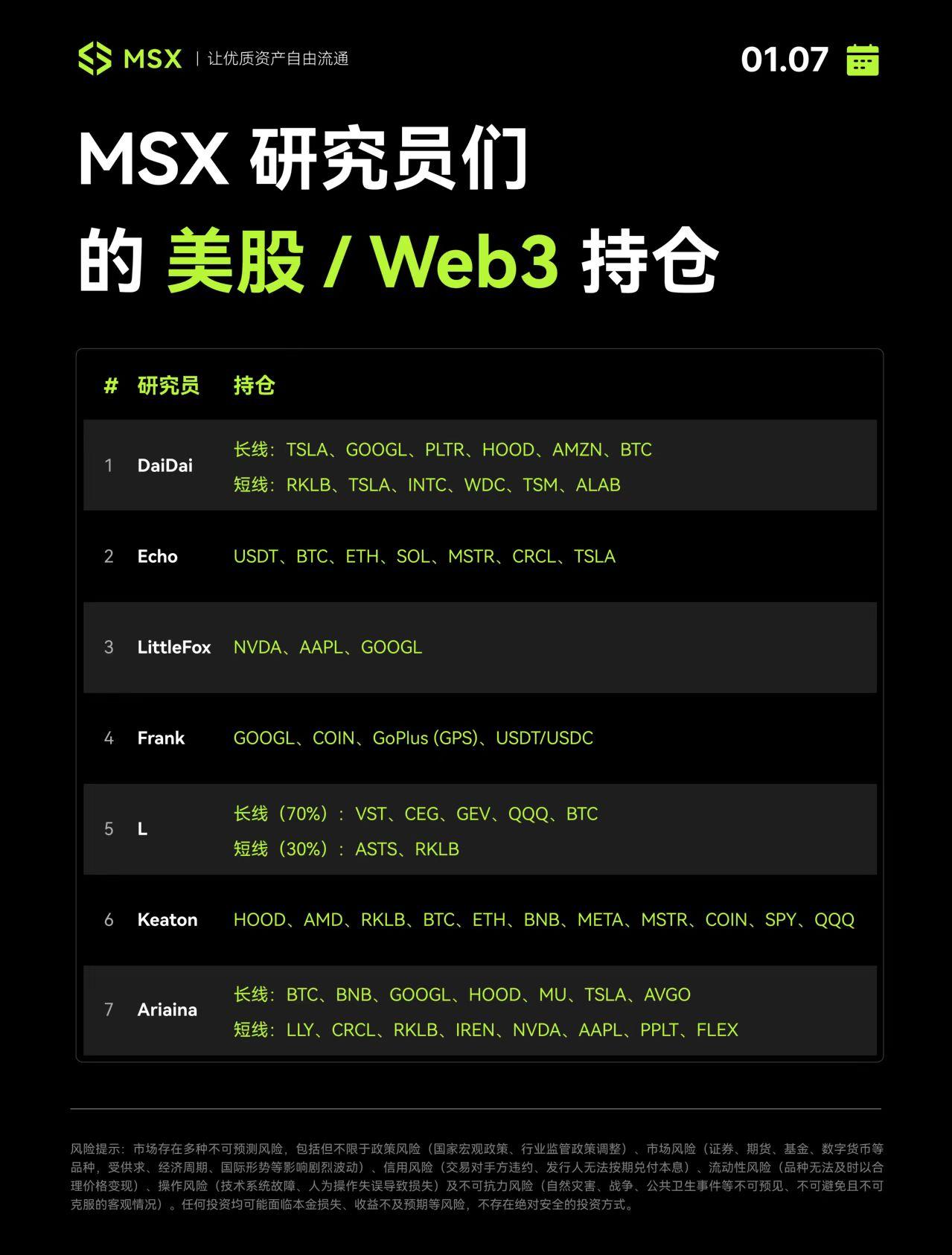
DaiDai: Long-term positions include TSLA, GOOGL, PLTR, HOOD, and AMAZN, while short-term positions include RKLB, TSLA, ONDS, ALAB, INTC, WDC, and TSM.
The logic behind short-term and long-term investing is quite different.
For short-term trades, like RKLB, ONDS, and TSLA, I'll use day trading to snowball my gains. After playing familiar stocks for a long time, you develop a so-called "feel" for the market, making it easier to grasp the rhythm. INTC, WDC, ALAB, and TSM are stocks I'm optimistic about in these two sectors and companies, but because I haven't clearly established a long-term position yet, and the cost basis isn't particularly low, they're currently just short-term plays, though I don't rule out turning them into long-term holdings.
In the long term, TSLA and PLTR are favored not only for their promising prospects but also primarily for their low costs; discussing them without considering costs is meaningless. Google is a stock I'm optimistic about, and I'm buying on dips; there's a saying this year, "Hide the bear market in Google." I've always felt AMZN is an undervalued stock, while AWS has solid performance to back it up; let's see if its value is realized. HOOD's products are truly excellent; it caught the crypto wave from late 2024 to 2025. In 2026, we'll mainly see if HOOD's new Social section will bring about a breakthrough.
LittleFox: Since I trade intraday, I'll talk about the stocks I usually trade. First is AAPL, which is an excellent stock, without a doubt, and very worthwhile to hold long-term. In my personal understanding, after Apple abandoned its car business, its strategic positioning became clearer. However, I trade intraday, so I don't hold any physical AAPL (I sold some physical shares following Warren Buffett's lead). I also occasionally short AAPL based on local information and market changes. For example, I short it during the Apple 17 launch last year and made a very good profit. Similarly, ONDS and TSLA are stocks I often trade in swings. Their price movements are very interesting. Although I mainly trade intraday, I rely heavily on the fundamental environment. Understanding the rhythm of fundamentals gives me confidence when opening positions.
As for the crypto industry, aside from BTC which I bought a long time ago, the only other thing I'm really looking forward to is MSX.
Echo: I started trading US stocks in the second half of 2025 and gradually accumulated the seven cryptocurrencies as my base position, following the market trend. My large position is in TSLA. I'm not betting on the car itself, but on the cards Musk holds—energy, AI, and robotics. I also have some MSTR and CRCL, which are like "anchors" for my crypto passion in the traditional market, and I'm just holding them.
In the crypto space, it's still the same old three: BTC, ETH, and SOL. These have always been my old friends that I bring home for the Lunar New Year; companionship is the most enduring expression of love.
Frank: Regarding US stocks, my core holdings are currently very concentrated in Google (GOOGL) and Coinbase (COIN).
GOOGL is a position I gradually built up after nearly three months of systematically studying US stocks and understanding the logic of tokenization and AI infrastructure. The cost is roughly around $250. Among the "Seven Sisters of US Stocks", whether in the early Internet era or in the future potential of AI, I have always preferred companies like Google that have both technological depth and commercialization capabilities. COIN is a stock I bought even earlier when I first opened my Interactive Brokers account. Regardless of whether I experienced deep losses or floating profits during that time, I did not sell it. Its symbolic significance outweighs its practical significance.
As I continue to catch up on my research on US stocks, I've also started to pay attention to RKLB and some storage/infrastructure-related sectors, but overall I'm still in the observation and small-scale trial phase.
In the crypto sector, core positions remain very restrained, with GPS (GoPlus) being more based on long-term observation of the security sector; USDT/USDC still accounts for a considerable proportion, mainly serving stablecoin arbitrage and liquidity needs.
Ariaina: My decision to invest in BTC for the long term remains firm. There's no particular reason; for me, choosing BTC doesn't require a complex logic. Bitcoin is the only consensus asset in the crypto world that has stood the test of time, and that's the minimum requirement for me to stay in this field. At this stage, I prefer to use BTC to represent my long-term judgment on crypto rather than wasting energy on high volatility and constantly changing narratives.
Regarding US stocks, I'm still a novice learner, and my overall investment is relatively small. However, within my limited portfolio, I've chosen to heavily invest in Google Cloud (GOOGL). From a business perspective, Google's core advantages are very clear: search and its browser constitute a stable and long-term traffic source; the Google suite has extremely high penetration in work and collaboration scenarios, becoming one of the basic infrastructures of daily life and work; and in the AI field, I value the long-term potential behind Gemini. Compared to simple model capabilities, Google possesses real and continuously generated data, a mature product system, and the ability to quickly deploy AI in high-frequency scenarios. At this stage, GOOGL is more like a core target for me to build understanding and observe long-term changes in the US stock market, rather than a short-term speculative object.
One more observation: looking back at the performance of the seven US stock market sisters in 2025, Google's maximum drawdown was about 24%, while its gains were about 76%. It may not be the fastest-rising or the one with the hottest story, but it is definitely the one that suffered the least when the market turned against it. In a sense, GOOGL is more like a core position that is "not so exciting, but allows you to sleep well", which is quite in line with my current risk appetite.
2026 will likely be a year full of excitement, with FIFA, the US midterm elections, and other short-term hot events creating short-term trading opportunities. I will participate in short-term trading in related sectors a few times during these exciting events, with the main goal of avoiding losses and the secondary goal of making money—if I can leave gracefully before the excitement ends, that would already be considered progress.
II. The Intersection of US Stocks and Crypto: Where Does the Money Come From and Where Does It Go?
4. If the Fed's interest rate cuts enter the mid-to-late stage, do you think global liquidity will first spill over into the US stock market, or push up BTC and Alt assets? Will the correlation between US stocks and cryptocurrencies increase or decrease in 2026?
DaiDai: First, liquidity follows an "overflow" logic, not an either/or choice. In the mid-to-late stages of interest rate cuts, US stock valuations are usually already inflated, and large funds find them too expensive to invest. At this point, the excess hot money will naturally overflow and flow into BTC and altcoins. Simply put, US stocks get their fill first, and only the leftovers will flow into the crypto market.
Secondly, the correlation will definitely decrease. Previously, the cryptocurrency market was a "follower" of the US stock market, with everyone watching the macro environment and rising and falling in tandem. By 2026, the US stock market may be busy looking at company performance and returns, while the cryptocurrency market will develop its own independent trend. There is a possibility that they will each play their own game, and we may see a situation where the US stock market is consolidating, but the cryptocurrency market is booming on its own.
If we consider the tokenization of US stocks, that would be a completely different scenario.
LittleFox: I think the current global liquidity is in a very strange state. Specifically, there is a lot of uncertainty in the global settlement system. So despite Japan raising interest rates, liquidity has not decreased, and precious metals have seen a surge in prices due to low inflation.
Against this backdrop, I believe the Federal Reserve's interest rate cuts are entering their mid-to-late stage. With a pace of one rate cut per year for the next two years, market liquidity will undergo a structural shift, primarily flowing towards assets with strong cash flow and the ability to generate sustainable revenue. In the US stock market, companies with good cash flow will receive more liquidity, while in the crypto market, assets that generate cash returns will also be more favored. This is because the uncertainty surrounding the global settlement system will lead most investment assets to prioritize preserving value rather than growth.
Echo: The water may first fill the largest lake (US stocks), then overflow into the most robust backup reservoir (BTC), and finally only irrigate the new ponds (selected Alt) that have self-storage capabilities (cash flow) or are located in key waterways (infrastructure), rather than flooding the entire plain.
In 2026, the correlation between US stocks and crypto will "structurally decline." Sometimes, they may move in tandem in the short term due to the same major news, but in the long run, the fundamental reasons for their price increases are diverging: the core of US stock pricing will return to "corporate profits," making it more of a "fundamental-driven" game; the core of crypto pricing will shift to "on-chain utility" and "protocol cash flow," making it more of a "utility-driven" game.
Separating assets is actually a good thing for investors, as it means that real opportunities for diversified asset allocation have arrived.
Frank: If the Fed’s rate-cutting cycle enters the mid-to-late stage in 2026, I am more inclined to believe that global liquidity will spill over to US stocks first, especially growth stocks with both performance and narrative support, rather than directly pushing up alt assets.
BTC may still be an important sentiment amplifier, but the full spread of altcoins requires more than just loose liquidity; it requires new narrative vehicles and structural demands.
Against this backdrop, I predict that the correlation between US stocks and cryptocurrencies will likely decrease in 2026. This is not because the two are completely decoupled, but because US stocks are moving towards a more institutionalized and predictable pricing system, while the internal differentiation within cryptocurrencies will further intensify.
Ariaina: If the Fed's rate cuts enter the mid-to-late stage, liquidity will likely first flow to the US stock market and then spill over to BTC and Alt, rather than the other way around.
For retail investors, the reality is simple: money flows to where prices are stable, drawdowns are minimal, and returns are high—the US stock market already demonstrated this in 2025. For institutions, the stock market is the main battleground for accumulating shares, leveraging, and controlling risk; crypto assets are often the next stop after risk appetite has been fully ignited. In the event of war or trade frictions, the first reaction of funds will still be gold and crude oil, not the safe-haven narrative of betting on BTC.
Therefore, by 2026, US stocks and cryptocurrencies are more likely to be boosted by liquidity together first, and then go through their own cycles, rather than continuing hand in hand.
5. Besides the chip ecosystem represented by Nvidia, which other US stock sectors also possess the characteristics of high volatility, high growth, and strong narrative? What indicators or signals do you usually use to identify these potential structural bull markets?
DaiDai: I personally think there are two options.
One is the space sector, which has an extremely high beta. If SpaceX makes a big splash, the smaller stocks in the entire sector (RKLB, AASTS, etc.) can jump 20% in a single day. I usually mainly look at deliveries, such as launch status and milestones; or large orders: for example, RKLB taking off after securing a NASA order; and the premium compared to SpaceX, as well as news about SpaceX—such as the potential surge in the space sector driven by SpaceX's anticipated IPO.
Another sector is nuclear energy and power infrastructure. The narrative logic is quite straightforward: AI data centers require massive amounts of electricity; at the very least, the purchased chips need to be plugged in, and the current power grid simply cannot handle the load. Under this logic, uranium mining and SMR (small modular reactors) are essential; their attributes are a typical combination of cyclical and growth-driven growth. Once a tech giant (like Microsoft or Amazon) announces the purchase of a nuclear power plant, this sector experiences a surge.
In addition, from a technical perspective, one can also pay attention to large orders in the grey market, as well as large option orders that are suddenly placed or expire (unusual whales), which may affect the stock price.
LittleFox: First, the timing of entry must be based on the consensus of sentiment provided by the fundamental environment, serving as a basis for judging whether the market is bullish or bearish. The timing of entry pays close attention to candlestick patterns, such as "W" bottoms and "M" tops on larger timeframes. If opportunities on larger timeframes are missed, then smaller timeframe patterns are considered. From a fractal theory perspective, similar patterns across different timeframes are still replicable; as long as historical market data has verified their effectiveness, the operation can be executed.
Echo: Basically, it's about finding the next "must-buy" story. In my experience (unreliable version), the best opportunities are hidden in places where "the story is incredibly plausible, but most people haven't figured out how much money it can make."
Large orders placed by leading companies in mainstream sectors such as biotechnology, defense and aerospace, and energy are perhaps the most reliable indicators of market trends.
Frank: Aside from the chip ecosystem represented by Nvidia, I personally pay more attention to those with high volatility (meaning that funds are willing to participate repeatedly) and narratives that can form a closed loop with reality (can be continuously verified by financial reports or events). However, I am still building my own specific methodology, so I won't embarrass myself by sharing it with you for now.
6. With the increase in trading volume of tokenized US stocks, do you think the pricing power of tokenized assets is more likely to be in the hands of Nasdaq in the future, or will it shift to on-chain DEX platforms?
DaiDai: The primary pricing power still rests with Nasdaq, but DEXs will take over the "all-day" premium. Nasdaq's biggest weakness is that it closes for the day (weekends, holidays, after the market closes), at which point DEXs become the only casino. Of course, the future 5x23h or 7x24h trading may bring different situations; we'll have to wait and see.
LittleFox: It must be on Nasdaq. DEXs only add channels for stock circulation, but they cannot determine the liquidity of the stock market. Currently, the total volume of stablecoins in the global market is still a drop in the ocean compared to traditional funds. It's wishful thinking to expect such a small amount of capital to influence the pricing power of stock assets. However, for some small-cap stocks, there might be some new possibilities, and the market is very much looking forward to it.
Echo: As the "birthplace" of regulation, Nasdaq will maintain its nominal pricing power for a long time, and people will still look at its prices as a benchmark. However, it will gradually become a place that mainly provides 24/7 reference prices.
The real pricing action will shift to on-chain DEXs. This is where prices are discovered, volatility is created, and arbitrage opportunities emerge first. Because it's faster, more global, and allows for an unlimited combination of trading strategies, the smartest money and the latest trends will flock here, naturally leading to the gradual acquisition of actual pricing power.
Frank: If Nasdaq officially launches tokenized US stocks, the initial pricing power will definitely remain with Nasdaq. After all, the foundation of rules, compliance, and liquidity depth lies in TradeFi, but on-chain DEX platforms will control off-exchange pricing power (such as 24/7 price speculation), and this power will eventually force Nasdaq to change its trading mechanism.
L: I prefer the outcome of "tiered pricing": In the short term, core pricing power will still be in the hands of major exchanges such as Nasdaq, because the deepest liquidity, information disclosure and clearing systems are still concentrated there; but as tokenized trading grows, on-chain DEXs will gradually gain marginal pricing power, mainly in non-trading hours, long-tail assets, and derivatives and leveraged trading scenarios.
Ultimately, it's not a replacement relationship, but a division of labor: traditional exchanges are responsible for the main anchor pricing, while on-chain markets are responsible for supplementing price discovery and global 24/7 liquidity.
Ariaina: In my view, pricing power is more likely to ultimately be in the hands of the party that pays the highest price for pricing errors, rather than the party that appears more authoritative or formally more decentralized.
Within the Nasdaq system, market makers, brokerages, clearinghouses, and regulators form a tightly intertwined system of shared interests and responsibilities: price errors, liquidity distortions, and abnormal fluctuations directly translate into real financial losses, compliance risks, and even legal liabilities. This environment, with its extremely high cost of error, naturally forces prices to be constantly corrected to a level closest to true supply and demand.
In contrast, DEXs rely more on liquidity depth and spontaneous corrections by arbitrageurs. Once liquidity is insufficient or the MM (Market Maker) crashes, price deviations directly punish not the party at fault, but the entire market – a cost that is undoubtedly enormous (see the 10.11 incident). Therefore, before tokenized US stocks are still anchored to real-world assets and have developed sufficiently deep on-chain institutional-grade liquidity, traditional markets like Nasdaq are clearly the party bearing the greatest responsibility and incurring the highest costs.
Of course, if enough top-tier market makers and enforceable accountability and penalty mechanisms emerge on the blockchain in the future, then pricing power may truly shift; otherwise, the blockchain will merely serve as a trading platform rather than a price referee.
III. Looking ahead to 2026, the investment chart of "crypto-US stock market investors"
7. In 2026, what is the core sector of the US stock market that you are most optimistic about and are willing to hold a large position in for the long term? Why?
DaiDai mainly consists of two sections: energy and grid infrastructure, and storage and space.
First, there's the energy and power grid issue. I now even feel that buying a power grid is more reliable than buying chips. In 2025, everyone was scrambling for computing power, but by 2026, the bottleneck will be entirely in electricity. Even with the best H100/H200, it's useless if the grid can't connect. The shortage of transformers and the aging power grid in the US are "infrastructure debts" that must be repaid. So, the bet is on the logic of "selling shovels": whether it's nuclear power (SMR) or upgrading old power grids, these are areas where tech giants must invest heavily to get AI running. This is a fundamental necessity with virtually no uncertainty.
Secondly, there's storage, because with the scaling up of AI, data storage becomes a necessity. Usage is growing rapidly, and demand is expanding just as quickly. Computing power (GPUs) handles production, while storage (NAND/HDDs) handles storage. The current situation is that high-end HBMs are hard to come by, and the production capacity of large-capacity enterprise-grade hard drives can't keep up. This isn't just a simple price increase; it's a transformation from a cyclical commodity to a necessity, an essential infrastructure.
As for space, SpaceX is expected to go public in 2026, what else is there to say?
LittleFox: In 2026, if we could only choose one core US stock sector that we would be willing to invest heavily in for the long term, the one we are most optimistic about is: AI infrastructure, including the entire chain of computing power and data centers, because it has certain spending growth, supply constraints and the characteristics of a layered layout of the industry chain, and it is highly likely that 2026 will still be in the middle of the upward cycle of capital expenditure.
Echo: Energy, the "shovel seller" of the AI era. It's not sexy, but the demand is unwavering, and the business is long-term. Instead of agonizing over which AI model company to invest in, why not directly bet on energy, which all AI companies rely on?
Frank: As for investing in US stocks, I am still learning, but at present I am most optimistic about commercial AI applications and computing infrastructure. This is not a hype, but because there is a real cash flow transfer happening in this field.
Ariaina: As a novice in US stocks, I can't claim to have a deep enough understanding of any particular sector. Rather than forcing a logical approach, I personally prefer to start with assets like the "Seven Sisters" that have been repeatedly validated by the market, as my "beginner's sanctuary." For me, this isn't about betting on which sector will definitely win, but rather about building a basic understanding first. Therefore, I prefer to prioritize "surviving long enough and seeing clearly" over "choosing the right stocks."
8. If a true "ChatGPT moment" occurs in 2026 involving TradeFi and tokenized US stocks, which variable do you think is most likely to trigger it? (For example, the normalization of 24/7 US stock trading, the formal inclusion of stablecoin legislation, or the marginalization of traditional clearing banks, etc.)
DaiDai: I have actually thought about this question. The real "ChatGPT moment" should be the moment when the public suddenly realizes that there is "no going back". The trigger point can be said to be the seamless payment of "Asset as Currency".
For example, when you swipe your card to buy coffee at Starbucks or pay a deposit on Tesla's official website, you don't need to sell your stocks to exchange for USDT or USD first; instead, you can directly swipe your TSLA tokenized shares in your account.
The "ChatGPT moment" of TradFi × tokenization will only arrive when you can use your TSLA like cash. Before that, all your 24/7 activities are just trading stocks in a different place.
LittleFox: I believe that the most important "ChatGPT moment" will be when compliant stablecoins are explicitly incorporated into the financial system, used on a large scale by banks and large financial institutions, and settled atomically with tokenized securities, thus upgrading on-chain as merely an issuance channel to an on-chain clearing layer. Nothing else is as important as this.
Echo: DTCC "officially intervenes," allowing financial institutions to provide users with instant buying, selling, and settlement of US stock tokens directly on the public blockchain.
Frank: If a "ChatGPT moment" really happens, I think the most likely triggering variable is not price, but the system, especially the full normalization of 24/7 US stock trading. This would completely activate global liquidity, and all kinds of possibilities surrounding downstream trading would enter a free kingdom. I think it is possible to replicate the wave of trading and product innovation of the 2020 DeFi Summer.
Keaton: There should be 1-2 on-chain brokerage products that can achieve the user experience and security guarantees of WeChat and Alipay.
Ariaina: I believe the real "ChatGPT moment" isn't about suddenly being able to trade anywhere or for how long, but rather when funds finally dare to go all-in. Just like DeFi doesn't lack protocols, it lacks answers about who's responsible if things go wrong. Efficiency determines usability, and regulation determines whether people dare to use it; the real turning point will definitely happen at the moment people "dare to use it."
9. A defensive strategy for those in the crypto and US stock markets: Given the increasingly similar volatility of these two asset classes, what is your hedging strategy? What percentage of your portfolio do you reserve in cash to deal with potential black swan events?
DaiDai: Diversify your portfolio by simultaneously allocating to US stocks (large position in large-cap stocks, small position in small-cap stocks), crypto (currently only trusting BTC and ETH), and precious metals. Keep 20% in cash to mitigate risk. Develop your own profit-taking and stop-loss logic, continuously optimize it, and improve your trading win rate.
LittleFox: When I trade, I only use 1/10 of my capital. Even if I open a full position with 10x leverage, it's still just a full position. If I need to hold an overnight position, this strategy mainly involves long positions. During the "1011 incident," my overnight long positions were filled, but they weren't liquidated due to the huge volatility. I didn't even feel anything because there was no forced liquidation price, and I still managed to exit with a profit.
Here I want to refute the premise of this question: due to the lack of liquidity, the crypto market can no longer completely align with the US stock market. If you want to make good investments, it is best to put most of your funds into the US stock market.
Echo: Use the quality of US stocks to hedge against the intensity of the crypto market. More of the portfolio will be allocated to US stock assets that can generate stable cash flow and have a lower limit on valuation, probably the Seven Sisters (a group of US stocks that have been heavily invested in cryptocurrencies). At the same time, the leverage and proportion of the crypto portfolio will be strictly limited, and the profits from the excess volatility of cryptocurrencies will be used to periodically supplement the US stock portfolio.
Frank: Personally, I plan to put about 80% of my discretionary investment funds into the US stock market by 2026.
It's not that I'm pessimistic about crypto, but I think everyone is easily trapped in their own path dependency. Those who experienced the DeFi Summer often have a not entirely rational expectation for the resurgence of on-chain prosperity.
For me, it's more important to maintain enough cash/stablecoins, control the frequency of trading rather than chasing every opportunity, and finally accept that I don't need to win every market at the same time.
Keaton: Don't short large-cap stocks; maintain healthy leverage.
Ariaina: True hedging isn't about techniques, but about low-leverage, small positions, ample cash flow, and the discipline to prevent emotions from making trades for you. The market is uncontrollable, but emotions are controllable. Once emotions are leveraged, what gets blown up isn't your position, but your understanding.