The Pi Network community is raising the alarm about a new scam that has emerged, resulting in millions of Pi Token being stolen from users' wallets.
This scam exploits the network's payment request feature and the transparency of blockchain data. This situation forced the Pi Core Team to temporarily disable the payment request feature as the number of losses continued to increase.
Pioneer members warn about scam methods that cause Pi to be withdrawn from wallets.
According to numerous community warnings Chia on X (formerly Twitter), scammers can scan Pi's blockchain data to identify wallet addresses and check Pi balances.
When a scammer detects a wallet containing a large amount of Pi, they will directly send a payment request to the wallet owner. If the recipient clicks "accept," the Pi will be immediately transferred to the scammer's wallet and will be irretrievable.
The Pi OpenMainnet 2025 community account warned that many people often misunderstand this as a technical error.
“Previously, many people called this a ‘system vulnerability,’ but that’s not actually the case,” the post explains . “This is exactly how the wallet is designed to work. You only lose Pi coins if you yourself agree to confirm the transaction.”
This post emphasizes that the primary risk stems from social media scams , not protocol errors. Scammers can make payment requests appear legitimate or impersonate acquaintances, causing users to unknowingly confirm transfers without checking carefully.
A large-scale scam
Blockchain transaction tracking data Chia by the community reveals that a single wallet address plays a central Vai in this activity.
The wallet address GCD3SZ3TFJAESWFZFROZZHNRM5KWFO25TVNR6EMLWNYL47V5A72HBWXP is alleged to have stolen between 700,000 and 800,000 Pi per month. In total, the amount of Pi stolen has exceeded 4.4 million Pi.
Data provided by Pi Network Update shows that the amount of Pi flowing into this address is consistent each month as follows:
- Approximately 877,900 Pi in July 2025
- 743,000 Pi in August
- 757,000 Pi in September
- 563,000 Pi in October
- 622,700 Pi in November, and
- Over 838,000 Pi in December.
These figures suggest this was an organized and sustained campaign, not just a series of isolated incidents. In particular, the surge in Pi purchases in December indicates that the situation is still escalating.
The incident has further increased the concerns of many Pi users – especially those new to on-chain transactions – as not everyone fully understands the risks of accepting money transfer requests from strangers.
Pi Team has temporarily suspended the payment request feature.
In response, the Pi team has temporarily disabled the "submit payment request" function. Community announcements confirm this decision was made due to the increasingly complex nature of the scam.
"Currently, the Pi team has temporarily suspended the function of sending requests like this (possibly because scams are becoming increasingly difficult to control)," the Pi Network Alerts account stated in a post.
However, this is only a temporary measure and not a long-term solution. This feature may be reactivated after additional layers of protection are added and safer user guidance is provided.
During this time, the network advises users to absolutely not accept or approve any payment requests sent to their personal wallets, regardless of who the sender is.
The warning also emphasized that scammers may impersonate friends, relatives, or even official Pi accounts.
This incident also highlights a major challenge for blockchain networks: balancing transparency, usability, and user security.
Although the Pi protocol works as designed, the recent incident demonstrates that, when exploited through social media scams, even standard features can become vulnerabilities for criminals.
At the time of writing, with the payment request feature still temporarily suspended for the year-end, Pi Network's PI Coin is trading at $0.20381, up nearly 1% in the last 24 hours.
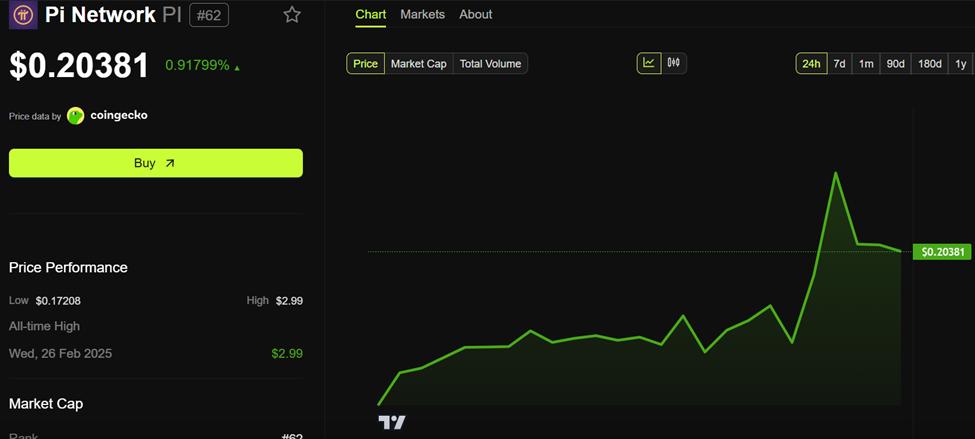 Pi Coin price fluctuations. Source: BeInCrypto
Meanwhile, Pi community members are actively monitoring suspicious wallets and continuing to raise awareness among users. Everyone is advised to be extremely vigilant as scams become increasingly sophisticated and widespread.