Investment fund a16z has just released its annual crypto forecast, predicting that the blockchain, AI agent, and global payments industries will undergo a major transformation by 2026.
This study highlights three key factors: the rise of automated AI agents, the gradual disappearance of payment systems from online platforms, and the privacy-focused blockchain era. These changes all signal a major structural reshaping of the internet's financial layers.
AI agents will bring about major changes.
According to a16z , the most significant change is that AI agents will directly participate in the economy . Currently, the number of agents is increasingly outnumbering employees in the financial services sector, with a ratio of nearly 100 agents per person.
However, these automated systems currently lack clear identification, authority, or compliance mechanisms. a16z suggests that by 2026, the first version of KYA: Know Your Agent will appear — an encrypted identifier layer that links agents to owners, limits liability, and regulates operations.
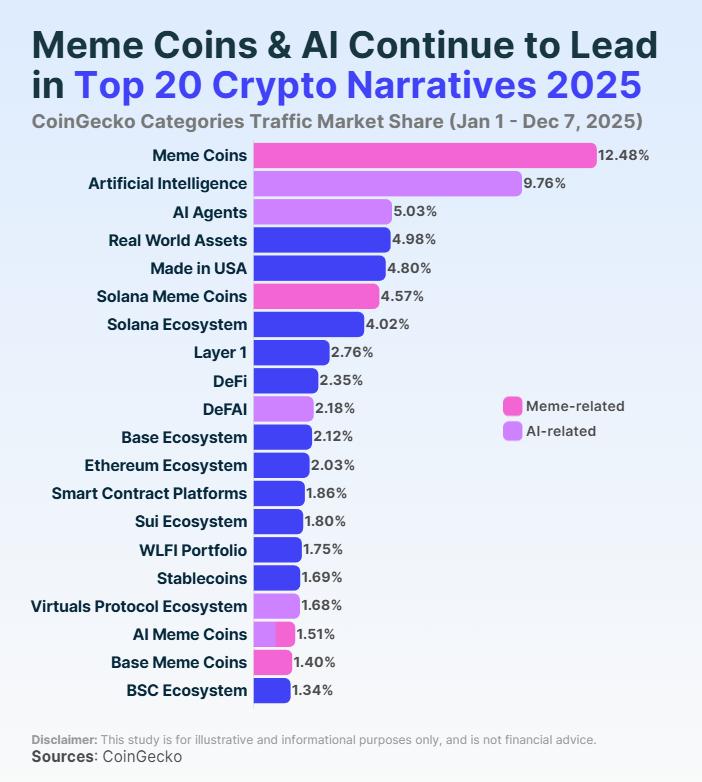 Top crypto trends for 2025. Source: CoinGecko
Without this identification layer, agents would be nothing more than "ghosts unable to trade," unable to access the market or trade securely. But thanks to KYA, agents become "market players" who can spend, buy, sell, and settle value in real time.
Payments disappear into the internet's infrastructure.
This change leads to a second major prediction: payment systems will "disappear" into the network. As AI agents automatically execute transactions such as purchasing data, paying for GPUs, or using APIs, the flow of money must also move as quickly and flexibly as the information.
New technologies like x402 will allow for instantaneous value transfer, without the need for permission or intermediaries.
With this model, payments are no longer an "application layer" but become a fundamental feature of the network. Banks, stablecoins, or payment systems become "invisible," merely serving as the underlying infrastructure that allows agents to transact with each other.
Secure chain will prevail.
Privacy is the third pillar in a16z's 2026 forecast. The research team believes thatprivacy will become the biggest competitive advantage in the crypto sector , surpassing even speed or processing capacity.
Specifically, as transactions become more private, switching to other blockchains becomes difficult for users because it could reveal confidential information. This creates a “ privacy lock-up ” effect, meaning that the platform that excels at privacy security will have a significant advantage.
Arthur Hayes also emphasized that large organizations are unlikely to accept the widespread use of blockchain if they continue to publicly disclose all their data by default.
"These large organizations don't want their information to be made public or at risk of being made public," he Chia , while predicting that Layer-2 privacy protection solutions may develop first, with Ethereum remaining the fundamental security platform.
Other predictions from a16z also mention the development of stablecoin infrastructure, the shift from Tokenize assets to directly creating assets on the blockchain, cloud computing with faster SNARK validation, and the emergence of “stacked media”—where commentators build credibility through public engagement on the chain.